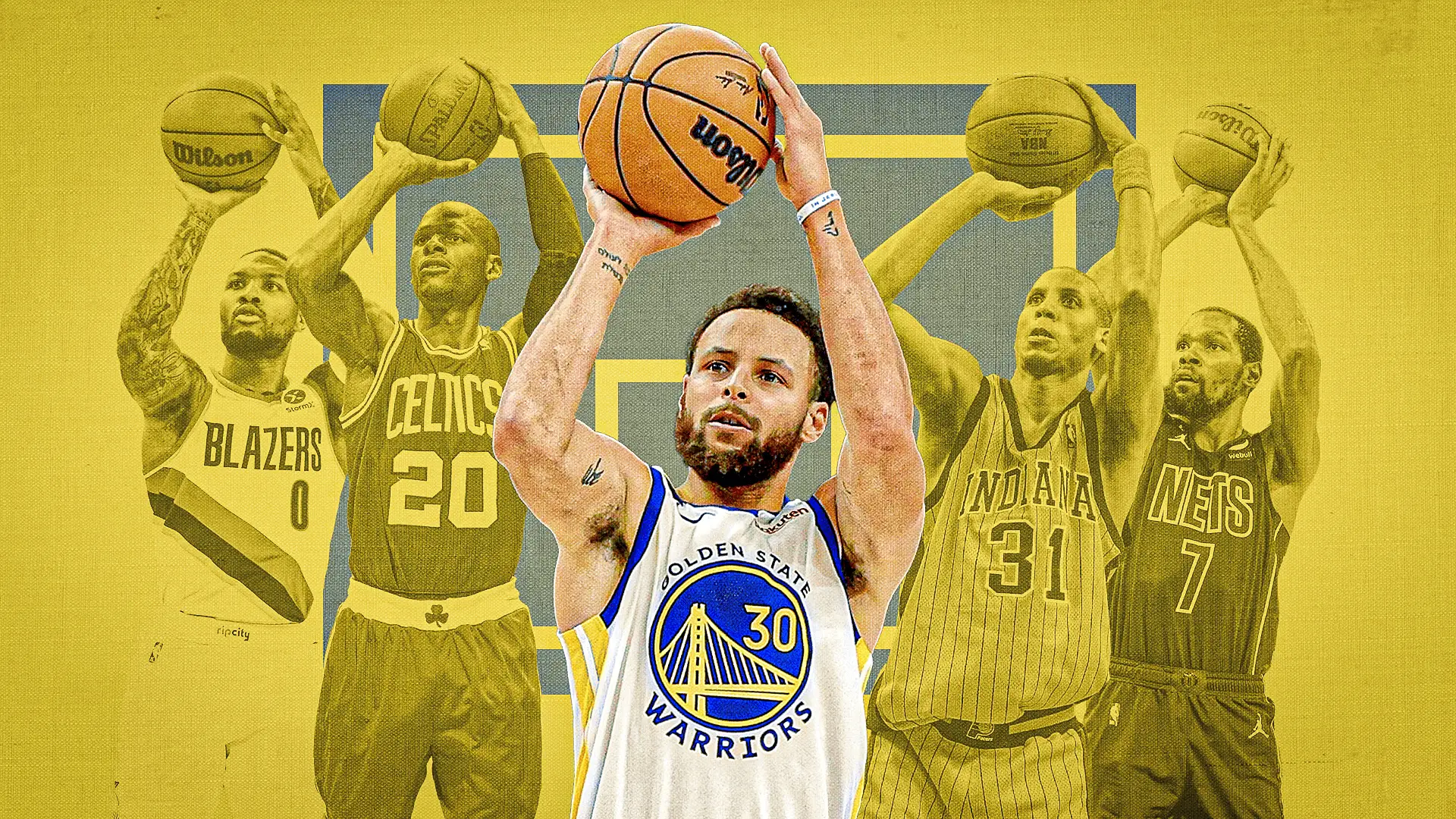
Did any rule change shape basketball more than the 3-point line? Since the NBA added it in the 1979 to 80 season, long-range shooting has gone from a twist to the core of modern offense. Teams space the floor, guards pull up from deep, and bigs stretch to the arc. That is why ranking the best long-range shooters NBA fans have ever seen still matters today.
This guide breaks down the best 3-point shooters in NBA history, who they are, how they did it, and why their impact lasts. Expect clear context, simple stats, and clutch moments that define the top NBA three-point shooters all time. You will see how volume, accuracy, range, and pressure shots set true greats apart.
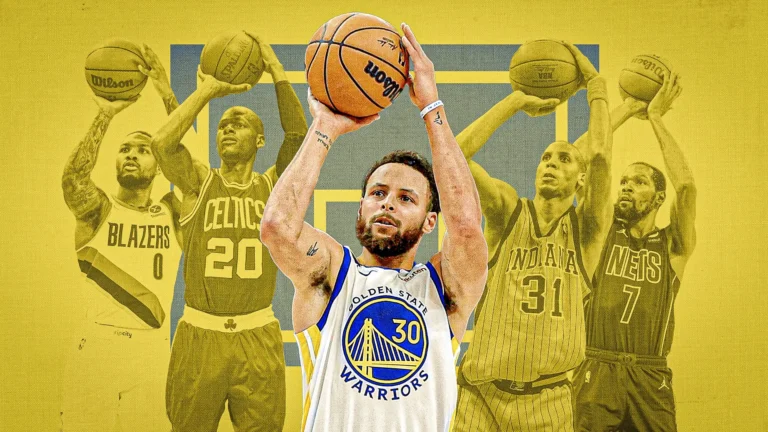
It starts with Stephen Curry, the all-time leader in makes and the standard for off-the-dribble threes. Before him, Ray Allen set the bar with pristine form, discipline, and big-time shots. Go back further and you find Reggie Miller, a master of movement and late-game daggers. Today, James Harden and Damian Lillard push distance and difficulty, proof that the arc keeps expanding.
We will highlight NBA 3-point shooting legends, compare styles, and show why some shooters bend defenses from the moment they cross half court. You will learn what separates spot-up specialists from off-movement snipers and pull-up artists. You will also see how era, role, and shot diet shape a legacy.
If you care about the greatest 3-point shooters basketball has produced, you are in the right place. By the end, you will know who truly owns the arc, who thrived when it mattered most, and where today’s stars fit in the all-time picture. Let’s get into the legends, from record-setters to clutch kings, and build a clear, fair list of the best.
How the 3-Point Shot Transformed NBA Basketball
The 3-point line flipped the value of space, speed, and skill in the NBA. Added in the 1979 to 80 season, it started as a test, then grew into the core of modern offense. Today, the best long-range shooters NBA fans celebrate define how teams play, practice, and draft.
From experiment to staple
The first official NBA three came from Chris Ford in October 1979. Early on, teams used the line sparingly. In 1979 to 80, clubs averaged about 2.8 attempts per game, well under five. Shooters like Pete Maravich and Larry Bird showed what was possible, yet coaches still leaned on post play and mid-range shots.
Across four decades, the math took over. Team attempts rose year after year and now sit over 35 per game. That is more than a tenfold jump. With more threes came more pace, more space, and a new map of the court.
Analytics and the 2010s boom
The mid-2010s unlocked the explosion. Front offices and coaches tied point value to shot selection in clear terms. Threes and layups graded out as the best shots. Stars who could pull up from deep became engines of elite offense.
- Drivers: Stephen Curry and Klay Thompson, Mike D’Antoni’s pace-and-space systems, and Daryl Morey’s emphasis on efficient shots.
- Result: Teams built around spacing, five-out sets, and high pick-and-rolls that force help defenders to choose wrong.
This shift crowned new types of NBA 3-point shooting legends and reframed what greatness from distance looks like.
Spacing, speed, and new roles
The arc reshaped jobs across the floor.
- Floor spacing: Defenses must guard 25 to 30 feet from the hoop, which opens lanes.
- Faster pace: Long rebounds and quick triggers fuel transition and early threes.
- Shot diet: Corner threes, pull-ups, and off-movement looks are now core plays.
- Stretch bigs: Centers who shoot drag rim protectors out of the paint.
- Clutch calculus: A late three can erase a two-possession gap in seconds.
This is the backdrop for ranking the Best 3-Point Shooters in NBA History. The top NBA three-point shooters all time did not just make shots. They changed spacing, dictated tempo, and expanded range. That is why the greatest 3-point shooters basketball has seen still shape how every team plays today.
What Makes a Great 3-Point Shooter? Key Ranking Factors
Great long-range shooters mix skill, intent, and repeatable habits. For our rankings of the Best 3-Point Shooters in NBA History, we balance volume, efficiency, difficulty, and impact. The goal is simple. Identify the top NBA three-point shooters all time who bend defenses and swing games.
Total Makes and Longevity
Total threes made shows endurance and consistent value across seasons. It captures health, role, and staying power. High totals also tell us a player earned trust from coaches and teammates over many years, not just a hot run. At the top tier, we see totals in the thousands, which anchors any case among NBA 3-point shooting legends.
- Example: Stephen Curry at about 4,058 made threes as of 2025.
Accuracy and Shot Profile
Career percentage matters, but context matters more. A 40 percent shooter on low attempts is not the same as a 40 percent shooter taking tough shots off the dribble. We weigh both the rate and the types of looks.
- Example: Curry’s career rate sits around 43 to 44 percent, which is elite for high volume.
Volume, Difficulty, and Range
Attempts per game, distance, and shot creation separate good from great. Pull-ups, off-screen bombs, and 28 to 30 foot range stress a defense every trip. Range that extends beyond the arc by several feet changes matchups and schemes.
- Example: James Harden’s 3,175 made threes at about 36.4 percent reflect massive volume on difficult, self-created shots.
Clutch Shooting and Context
Big shots in tight moments carry extra weight. Fourth quarter makes, late-clock threes, and playoff shot-making matter. We look for repeat clutch success, not one highlight.
Role, Era, and Portability
Era sets pace, spacing, and shot diet. Roles shape how often a player shoots and from where. We reward shooters who thrive across systems, who scale from spot-up looks to high-usage pull-ups. That blend defines the greatest 3-point shooters basketball has produced and guides our rankings of the best long-range shooters NBA fans still study today.
Top 5 Best Long-Range Shooters in NBA History
Here is a clear, ranked look at the best long-range shooters NBA fans still debate. Each profile blends totals, efficiency, shot difficulty, and lasting impact. These are the NBA 3-point shooting legends who changed spacing, pressure, and late-game math for good.
Stephen Curry: The Ultimate 3-Point Revolutionizer
Stephen Curry sits at the top with unmatched range and rhythm. He owns the record for total threes with 4,058, and he still hits at roughly 43 to 44 percent. No star mixes volume and accuracy like this. His release is fast, repeatable, and balanced on or off the dribble.
Curry’s 2015 to 16 season reset the bar. He made 402 threes, a number that once felt impossible. Defenses started picking him up 30 feet from the hoop. That space opened the lane and turned simple handoffs into high-value actions.
His off-ball movement is a masterclass. He sprints through screens, relocates to seams, and punishes a half-step late closeout. Those patterns make teammates better and strain schemes for full games. Coaches plan entire coverages around him.
The results are obvious. Multiple championships, MVPs, and a dynasty built on pace, space, and confidence. Kids rehearse the sidestep from 28 feet because Curry proved it was a real shot. Among the greatest 3-point shooters basketball has produced, he is the standard and the template for the top NBA three-point shooters all time.
- Signature traits: deep range, off-ball chaos, pull-up precision
- Crowning stat: 402 threes in a single season
James Harden: Master of High-Volume Threes
James Harden turned the step-back three into a weapon you could count on. He ranks second here by sheer output and creation, with 3,175 threes at about 36.4 percent. The percentage is solid, yet the volume and difficulty tell the story. So many shots were self-made, late clock, and over set defenders.
The Houston Rockets built an offense around his isolation scoring. They cleared a side, spaced four shooters, and let Harden read the floor. If help came, he kicked. If not, he stepped back, created a pocket of space, and fired. It was efficient math and a repeatable play.
His MVP seasons featured streaks of 30-point nights powered by threes off the bounce. He drew fouls, manipulated angles, and punished bigs on switches. That style drove massive attempts without wrecking team offense.
Harden’s legacy sits on volume, creation, and reliability. He lived at the top of the arc and still bent defenses inside. For the best long-range shooters NBA history remembers, not many carried a larger three-point load for longer.
- Signature traits: step-back, isolation creation, foul pressure
- Crowning stretch: Rockets era with historic usage and 3-point attempts
Ray Allen: The Hall of Fame Sharpshooter
Ray Allen brought pristine form and a pro’s routine to every stop. He finished with 2,973 threes and a career rate over 40 percent. That blend of volume and accuracy held the record for years and still anchors his place among NBA 3-point shooting legends.
He did it across eras and roles. With the Bucks and Sonics, he scored off the dribble and in transition. In Boston and Miami, he became the perfect spacer, sprinting off pin-downs and rising with zero dip. The mechanics were picture clean. Feet set, shoulders square, high release.
The defining moment came in the 2013 Finals. In Game 6, he backpedaled to the corner, caught, and hit the season-saving three. The footwork, the calm, the shot. That single make symbolizes why coaches trust structure and shooters trust reps.
Allen’s steadiness still guides young players. His off-day workouts built muscle memory that lasted until June. Among the top NBA three-point shooters all time, he is the blueprint for consistency, discipline, and clutch readiness.
- Signature traits: pure form, conditioning, movement shooting
- Crowning moment: 2013 Finals corner three for Miami
Damian Lillard: Clutch Shooter from Deep
Damian Lillard turned the logo into a launch pad. He sits with 2,804 threes at about 37.5 percent, and much of it comes from extreme range. Those bombs force defenders to pick him up at half court, which reshapes every possession.
Lillard’s playoff resume is filled with cold-blooded shots. The 2019 series winner over Oklahoma City was a 37-foot dagger. He waved goodbye, and the clip looped all summer. That confidence shows up in fourth quarters, where he hunts space and pulls before the help can react.
His time in Portland showed rare loyalty and leadership. He carried high usage, drew traps, and still kept teammates involved. Even when the rate dipped under heavy attention, the threat from 30 feet held value. Defenses could not stash a weak defender on him and hope.
The best long-range shooters NBA fans love mix drama and repeatable skill. Lillard does both. He blends pull-up power, deep range, and late-game poise that travels from October to May.
- Signature traits: logo range, pull-up burst, clutch nerve
- Crowning moment: series winner vs. OKC from well beyond the arc
Klay Thompson: Splash Brother Extraordinaire
Klay Thompson brings balance to the Warriors machine. He owns 2,697 threes at about 41 to 42 percent, which is elite on heavy attempts. His quick release is the headline. He barely dips, sets his feet on the catch, and fires before the closeout arrives.
Klay does not need the ball to be dangerous. He cuts, flares, and relocates into open windows that Curry’s gravity creates. Then he punishes every late rotation. He once scored 37 points in a single quarter and hit 14 threes in a game, both feats built on footwork and timing rather than dribble volume.
During the 73-win season, he stacked threes as a perfect off-ball counter to Curry’s pull-ups. On defense, he guarded primary wings, which let the Warriors keep shooting on the floor without sacrificing stops. That two-way value helps explain multiple rings.
His comeback from major injuries added a new layer to his story. He returned, found rhythm, and kept the form that made him a fixture among the greatest 3-point shooters basketball has seen.
- Signature traits: quick release, movement shooting, two-way value
- Crowning feats: 37-point quarter, 14 threes in one game
These five rank as the Best 3-Point Shooters in NBA History based on makes, accuracy, difficulty, and big moments. They define the top NBA three-point shooters all time, from Curry’s deep pull-ups to Klay’s instant catch-and-shoot. The arc belongs to players who create space, hit under pressure, and keep forcing new defensive answers.
Conclusion
The arc belongs to specialists who mix volume, accuracy, and nerve. Stephen Curry set the standard for range and off-dribble rhythm. James Harden proved how sustained, self-created threes can power an offense. Ray Allen showed perfect form and clutch readiness that travel across eras. Damian Lillard brought logo range and late-game calm. Klay Thompson turned movement and a rapid release into relentless pressure.
These NBA 3-point shooting legends changed spacing, tempo, and late-game math. They define the best long-range shooters NBA fans study, and they anchor any fair list of the top NBA three-point shooters all time. Their marks are clear, from Curry’s record totals to Allen’s Finals footwork, from Harden’s step-back streaks to Lillard’s series winners, and Klay’s 37-point quarter.
The next wave is coming. Young guards pull from 28 feet with ease, wings fire off movement, and bigs stretch to the corners. Training and tracking sharpen shot quality, and the line keeps shaping strategy. The greatest 3-point shooters basketball will celebrate next will blend deep range, quick decisions, and playoff poise.
Share your favorite moments, debate the order, and add names you think belong. Keep the conversation sharp and the standards high. If you care about the Best 3-Point Shooters in NBA History, this is your space to weigh in and push the list forward.
About the Author